
Clash of Empires World War 2 The Battle of the Atlantic 1939-40
- martinboulter2020
- May 4
- 5 min read
Updated: May 10
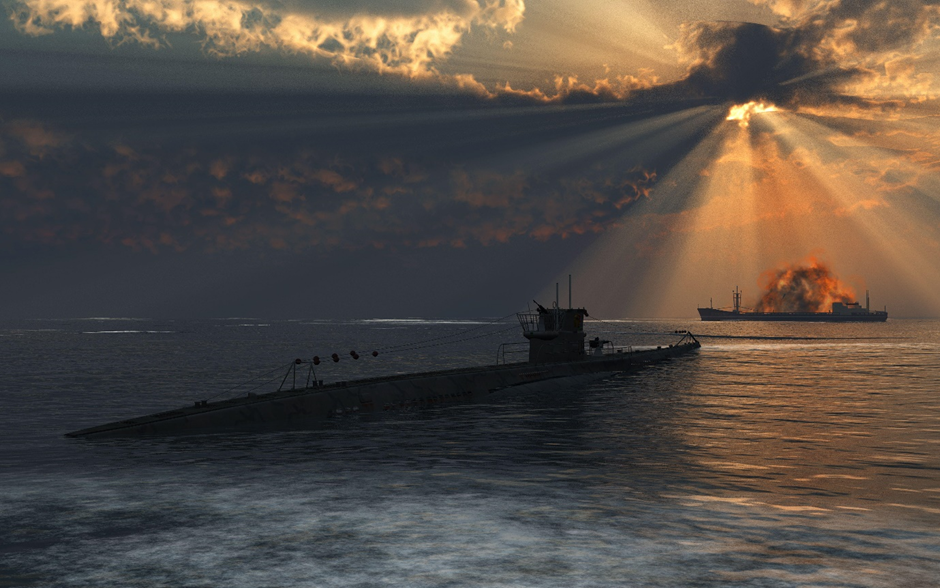
This article is intended to use the Clash of Empires Battle System to recreate one of the opening skirmishes of the Battle of the Atlantic as Germany commenced its strategy to try and break Britain by strangling its maritime trade. No sooner had the war began than the Kriegsmarine deployed its surface raiders such as the pocket battleships Graf Spree and the Deutschland to the Atlantic. However, their impact was negligible compared to that of the German U-boats that operating singly and in groups known as wolf-packs ravaged Allied shipping. Thus, an epic struggle ensued as the Royal Navy tried to counter the U-boat menace.
Background
The biggest campaign of the entire naval war, the Battle of the Atlantic was waged between the Kriegsmarine’s U-boats, surface raiders and aircraft on one side and merchant shipping, navies and aircraft of the allies on the other. Early skirmishing began in 1939 when the Kriegsmarine, instead of directly confronting the allied French and British navies for control of the sea, adopted a strategy of commerce raiding. As an island nation, the United Kingdom was dependent upon imported goods and it was this trade and later the build-up of military supplies that the Germans intended to block. British countermeasures such as a convoy system and hunting groups of warships failed to eliminate the U-boat threat and this period ended in a number of German successes. Notable amongst these was the sinking of the aircraft carrier HMS Courageous on 17th September. Even this was surpassed a month later when a U-boat penetrated the naval base at Scapa Flow and sunk the old Battleship Royal Oak at anchor. After this initial burst of activity, the Atlantic Campaign quieted down, as U-boats returned to harbour for re-supply and re-fit.
The intention of the following scenario is to recreate one of the first group attacks by U-boats albeit a small one. Early in October 1939 a pack of six U-boats were ordered to concentrate south of Ireland to make attacks upon convoys. Due to various reasons only three managed to make it to the rendezvous. These were U-37 which was under the command of W. Hartmann who was designated tactical commander of the group plus U-46 and U-48. On the 17th of October they attacked the home-bound convoy HG3 which consisted of 27 unescorted merchant vessels. Despite torpedo failures each U-boat sank one vessel before being driven off by air support. Although an unobtrusive affair in the annals of the Battle of the Atlantic this operation against HG3 did prove the potential effectiveness of pack attacks on convoys.
Using the Clash of Empires rules the battle strength and capabilities of the combatants can be shown as follows: -
Conversion and Casualty Tables not shown.
Following Ship and Convoy Detection six U-boats are ordered to rendezvous south of Ireland. 1D6 is rolled to determine how many U-boats make it to the target area on time. 1D6 = 3
German Force
The attacking German force consists of three U-boats. At this stage in the war the Kriegsmarine U-boat fleet is rated as Ordinary and the U-boats have a Combat Rating of ❻ versus unescorted merchant ships and ❹ against escorted ones. On the Combat Rating (CR) to Fighting Bonus (FB) Conversion Table this equates to +9 FB for the three U-boats attacking an unescorted convoy. Owing to their torpedo firing capability U-boats get a Battle Factor modifier of +2. Normally subs can fire two salvos of torpedoes against targets. However, due to problems with the depth control and detonators of early war German torpedoes this is reduced to one effective salvo per U-boat for this scenario. Due to their stealth submarines get +1 to Initiative.
Commander
Kapitänleutenant Werner Hartmann is a successful U-boat commander and tactical leader and in the game is ranked as Competent +1 Initiative.
Convoy HG3
The convoy HG3 consists of 27 unescorted merchant ships. They are rated as Ordinary and have a Combat Rating of ⓿. Nevertheless, they still get a token +1 FB per 10 ships which represents the fact that they are faster than the attacking U-boats and have some ramming potential. This means that the convoy has a total FB of +3. Crucially inshore air support can be called in on a score of 4-6 on 1D6.
Air Support
If successfully called in air support is provided by an inshore unit of aircraft armed with anti-submarine bombs. This will give the convoy a special 1D6 Advantage Die.
Pre-set Scenario Condition: Convoy HG3 has failed its Intelligence and Reconnaissance Roll and therefore is subject to a Surprise Attack. This means that the U-boat Raiders get an extra +2 Initiative.
World War 2 Battle Log
German U-boat Raiders
Initiative | Battle Dice (Modifier) | No. of Units and CR to Fighting Bonus | Battle Bonus Normal (Enhanced) | Battle Advantage Dice | Total Score |
1D6 +4
4+4 = 8
| 2D6 (+2)
4 and 5
(Highest die only)
5+2 = 7 | U-boats
❻ x3 = +9 FB | No odds or evens
1D6(2D6) 1D6 = 3 | Tactical Advantage 2D6
3+1 = 4 | 7+9+3+4 = 23
|
Convoy HG3
Initiative | Battle Dice (Modifier) | No. of Units and CR to Fighting Bonus | Battle Bonus Normal (Enhanced) | Battle Advantage Dice | Total Score |
1D6 = 3 | 2D6 (+0) 5 and 3 (Highest die only)
| Unescorted merchant ships
⓿ x 27 = +3 FB
Air Support 4-6 = 5 | Odds Dice
1D3(1D6) 1D6 = 2 | Anti-submarine bombs 1D6
= 5
| 5+3+2+5 = 15 |
WW2 Army Battle Bonus Calculation Table not shown.
Battle Bonus calculation determined by Navy Type and Fighting Bonus (FB).
(#D#) = Enhanced Battle Bonus on odds or evens Battle Dice.
Note: - The German U-boat raiders win Initiative by 3 or more which yields a 2D6 Tactical Advantage. They don’t roll odds or evens Battle Dice so are restricted to an ordinary Battle Bonus. The total Battle Roll score equals 23 which when compared with their opponent’s score gives a differential of 8. This provides a +2 modifier on the Casualty Table versus 3 targets (2 salvos = 6 targets). Therefore, in the resultant skirmish a salvo of torpedoes from each U-boat sinks two merchant ships and cripples one other. As a result of the convoy’s success at calling in air support anti-submarine bombs cause 25% damage to 2 subs and drive all three off. A differential of 8, in their favour, allows the U-boats to roll at -3 on the Casualty Table. It is interesting to note that if there had been no problems with the torpedoes and if more U-boats had made it to the rendezvous, then this skirmish might well have been elevated to a major success for the Kriegsmarine and a dire warning of things to come for the British.

Sources
Dupuy, R. E. and Dupuy, T. N. 1993: The Collins Encyclopaedia of Military History. Harper Collins Publishers.
Jones, G. P. 1988: U-Boat Aces. William Kimber & CO. Limited.
Mayer S. L. Various Contributors. 1977: Encyclopaedia of World War II. Hamlyn Publishing Group Limited.
Article Front Page Picture
A Nazi German U-Boat attacking a sinking Allied cargo ship somewhere in the Atlantic Ocean. Artist: MasPix. After Alamy (IY05614556).


Comments