
Clash of Empires World War 2 The Soviet-Finnish War 1939-1940
- martinboulter2020
- May 10
- 8 min read

The purpose of this article is to use the Clash of Empires Battle System to recreate a significant phase of the Finnish-Soviet Winter War 1939-40. This conflict was essentially a land grab by Stalin to protect Leningrad in the north and was part of a wider strategy to create a buffer against German aggression. Already the Baltic states of Latvia, Lithuania and Estonia had been bullied into signing mutual defence agreements. Next Stalin turned his attention to the unaligned tiny country of Finland which now found itself pitted against its huge and threatening Soviet neighbour with all its vast resources in manpower and equipment. Nevertheless, the unyielding Finns put up a stout defence of their homeland inflicting heavy casualties on the Red Army. During the 105 days of their heroic resistance the Finns provoked both sympathy and admiration abroad but crucially there was no foreign intervention. Therefore, by sheer weight of numbers the Russians eventually won, but the campaign had been a humiliating experience for Stalin and was ultimately a hollow victory which destroyed the reputation of the Red Army. It was this perceived weakness that encouraged Hitler to attack the Soviet Union in 1941. The Soviet Finnish War was the first round in the struggle for Scandinavia and would be followed by Germany’s operations against Denmark and Norway.
Background
On the 30th of November 1939 Soviet forces invaded Finland with 21 divisions, totalling some 450,000 men. At the same time Helsinki was bombed. The Soviets expected a quick blitzkrieg type of victory but failed to consider the difficult terrain which consisted of trackless forests and swamps. Furthermore, Stalin’s Great Purge of 1937 had robbed the Red Army of many of its best officers. Thus, despite a more than 3 to 1 numerical superiority the Russian offensive soon began to stall. In battles from Ladoga Karelia all the way north to the Arctic port of Petsamo, the Finns used guerrilla tactics. The Red Army was superior in numbers and materials, but the Finns used the advantages of speed, tactics and economy of force. Particularly on the Ladoga Karelia front and during the battle of the Raate road the rapidly moving Finnish ski troops ambushed the enemy columns forcing them into pockets or motte. With the Russian forces divided into smaller sections the Finns could deal with them individually and attack from all sides. Furthermore, the weather was exceptionally cold and many Soviet soldiers froze to death.
The terrain on the Karelian Isthmus, however, did not allow the exercise of guerrilla tactics, so the Finns were forced to resort to the more conventional Mannerheim Line, an array of defence structures, with its flanks protected by large bodies of water. Here the Red Army suffered heavy losses as it launched attack after attack without success. Thus, the soviet advance was stopped at the Mannerheim Line. Red Army troops suffered from poor morale and shortage of supplies, eventually refusing to participate in more suicidal frontal attacks. At this point the Finns launched a bold counterattack, but it failed, with both sides suffering heavy casualties.
Joseph Stalin was not pleased with the results for the first month of the Finnish Campaign. The Red Army had been humiliated. A new commander Timoshenko was put in charge of Soviet forces. And the main focus of the Soviet attack was switched to the Karelian Isthmus. After a huge build-up of men, Tanks and artillery (i.e., 25-26 divisions totalling some 600,000 men) the Red Army began a massive offensive which gradually ground the Finns down and forced them to retreat. By mid-February, it became clear that the Finnish forces were rapidly approaching exhaustion. Later that month they entered peace negotiations.
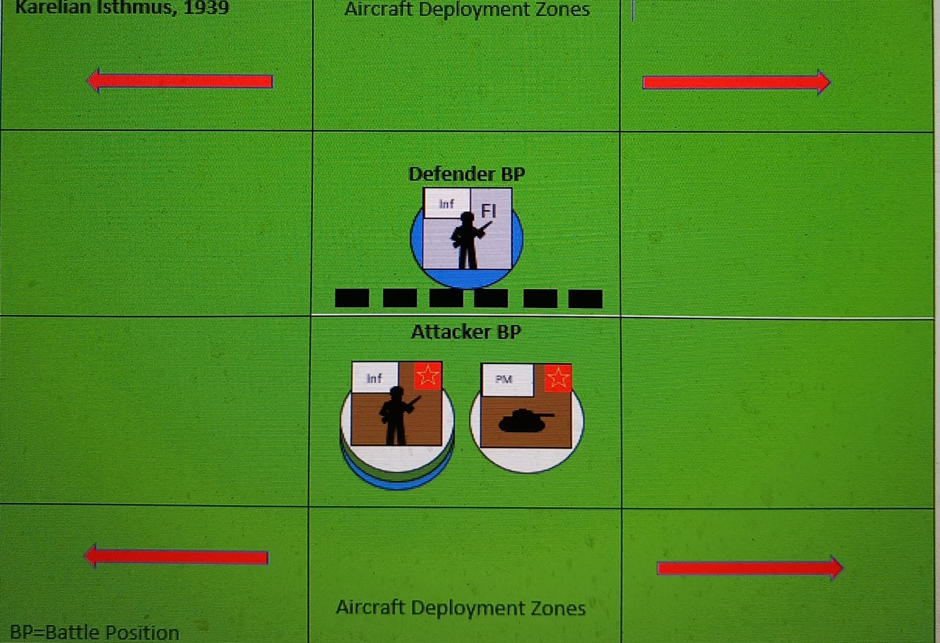
This scenario focuses on using the Clash Battle System to recreate the initial main Soviet offensive against the Mannerheim Line on the Karelian Isthmus, 6-27 December 1939. Here the Soviets expected to achieve a quick breakthrough using a frontal assault. This was to be followed by the capture of the strategically important road junction at Viipuri, which would open the route west to the Finnish capital Helsinki. This overall task was given to the 9 infantry divisions (250,000 men) and 3 tank brigades of the Soviet 7th Army under the command of Yakovlev. Facing them were the 5-infantry divisions (130,000 men) of the II and III Corps under the command of Lieutenant-General Österman. These Finnish troops occupied defensive positions running from the Gulf of Finland to Lake Ladoga. The Mannerheim Line was a 1st World War system of field fortifications which cleverly incorporated several water features including marshland that the Soviet infantry would have to cross. The main Soviet assault was directed towards the eastern part of the line and was preceded by a lengthy artillery barrage. In its wake the massed Soviet infantry and tanks pressed forward, but as soon as they entered a pre-arranged killing zone the Finns opened fire with their own artillery and support weapons. The murderous intensity of this fire power hurled the Russians back with heavy losses. Supporting attacks along the line also failed. Thereafter the attacks on the Karelian Front stalled and as the Finnish winter deepened sub-zero temperatures set in and many thousands of the poorly equipped Soviet troops froze to death.
Using the Clash of Empires rules the battle strength and capabilities of the combatants can be shown as follows: -
A typical division is between 15,000 and 20,000 men strong.
Soviet Forces
The Soviet infantry divisions are made up of raw conscript troops who are untrained and poorly equipped for the freezing conditions of the Finnish winter. They are supported by light tanks such as the T-26 but there is very little cooperation between these arms. To reflect this the Soviet forces are rated as Inferior and are therefore subject to a -1 penalty to Initiative. The Soviet 7th Army is made up of 9 infantry divisions and 3 tank brigades. The infantry divisions have a Combat Rating (CR) of ❶ and the tank brigades can be treated as the equivalent to a Part Mechanized Division with a Combat Rating of ❸. On the Combat Rating (CR) to Fighting Bonus (FB) Conversion Table in the rulebook this equates to +4 FB for the Infantry Divisions and a +1 FB for the Part Mechanized Division. The infantry divisions also have artillery support which based upon accumulated FB converts to a 1D3 Artillery Advantage Die. The Soviet forces have air support but it is uncoordinated so there is no advantage die for Strafing and Bombing. Contributing Battle Factor modifiers consist of +1 for Light Tanks in Offence and +1 to Close Assault for Engineers. This gives the Soviet Forces a +2 modifier which is added to the Battle Dice score. Due to limited Air Assets, there is no Close Air Support. Because the Russians outnumber the Finns, they get a 1D6 Battle Advantage Die.
Soviet Commander
The commander of the 7th Army (Karelian Isthmus) is Army Commander, 2nd Class Vsevolod F. Yakovlev. Close to Stalin, Yakovlev survived the Great Purge (1936-38), but like most of the senior Soviet commanders displays a lack of initiative and organisational skill. For this reason, in the game Yakovlev is ranked as Average and therefore rolls 1D6 for Initiative.
Finnish Forces
The Finnish army is made up mostly of mobilized infantry reservists that are well trained and inured to the hardships of the Finnish winter conditions. This gives them a rating of Ordinary and a Combat Rating of ❶. There are 5 infantry divisions defending the Karelian Isthmus and on the Combat Rating (CR) to Fighting Bonus (FB) conversion table in the rulebook this equates to +2 FB. Due to budgetary constraints Finland’s tank force is almost non-existent and anti-tank guns are in short supply. Instead, the Finns rely upon improvised anti-tank weapons such as molotovs and satchel grenades. The infantry divisions have artillery support which based upon accumulated FB converts to a 1D3 Artillery Advantage Die. Finnish Battle Factor modifier is +2 to Small Arms for Infantry in Defence (Entrenched), which is added to the Battle Dice score. The Finns have no significant air support. However, the Finnish troops are firmly established in a strong defensive position (i.e., the Mannerheim Line) which consists of intermittent concrete bunkers and trench lines cleverly incorporated into the harsh terrain. This provides 3D6 Battle Advantage Dice.
Finnish Commander
The Finnish commander in charge of the defence of the Karelian Isthmus is Lieutenant-General Hugo Österman. An organized and capable commander Österman in the game is ranked as Competent and therefore rolls 1D6 +1 for Initiative.
Pre-set Scenario Condition: Battle of Attrition defending a Fortified Line. No Surprise.
WW2 Clash Battle Procedure:
After rolling for Initiative the Battle Roll for each army consists of the following procedure:
Battle Dice 2D6 (highest scoring die only).
Army Combat Rating (CR) to Fighting Bonus (FB).
Calculate Battle Bonus. (Determined by Army Type and FB).
Any other Battle Advantages such as Artillery Bombardment, Opponent outnumbered or Tactical Advantage.
Total Battle Roll.
Highest scoring Battle Roll wins and the difference between the two scores determines the number of casualties.
Combat Rating to Fighting Bonus Conversion and Casualty Tables not shown.
World War 2 Battle Log
Soviet Forces (Karelian Isthmus)
Initiative | Battle Dice (Modifier) | No. of Units and CR to Fighting Bonus | Battle Bonus Normal (Enhanced) | Battle Advantage Dice | Total Score |
1D6-1
3-1 = 2
| 2D6 (+2)
4 and 4
(Highest die only)
4+2 = 6 | Inf ❶ x9 = +4 FB PM ❸ x1 = +1 FB
Total = +5 FB
Uncoordinated Air Support | Evens Dice 1D3(1D6) 1D6 = 2 | Opponent Outnumbered 1D6
Artillery 1D3
5+2 = 7 | 6+5+2+7 = 20 |
Finnish Forces (Karelian Isthmus)
Initiative | Battle Dice (Modifier) | No. of Units and CR to Fighting Bonus | Battle Bonus Normal (Enhanced) | Battle Advantage Dice | Total Score |
1D6 +1
2+1 = 3
| 2D6 (+2)
5 and 3
(Highest die only)
5+2 = 7 | Inf ❶ x5 = +2 FB
No Air Support | Odds Dice 1D3(1D6) 1D6 = 4
| Strong Defences 3D6
Tactical Advantage 1D6
Artillery 1D3
6+4+3+2+2 = 17 | 5+2+4+17 = 28 |
WW2 Army Battle Bonus Calculation Table not shown.
Battle Bonus calculation determined by Army Type and Fighting Bonus (FB).
(#D#) = Enhanced Battle Bonus on odds or evens Battle Dice.
Notes: - A disappointing Soviet Initiative score hands the tactical advantage to the Finns as the advancing Russians, restricted by terrain, find themselves stuck in a killing zone where direct and effective fire turns their attack into a bloody shambles. The outcome of this is that the Soviet attack is repulsed with huge losses. A differential of 8 between the two Battle Rolls results in a +2 modifier on the casualty table for the losing Russians. Thus, in the fighting in this sector the Soviets lose the equivalent of 5 divisions destroyed or routed. As the Finnish winter set in many of these casualties can be attributed to the freezing conditions. The Finns lose the equivalent of 75% of one division.
Breaking the Mannerheim Line, Feb 1940
Following a change of leadership to the competent General Timoshenko and massive reinforcement the Soviets managed to break through the Mannerheim Line on the 13th of February 1940. Using the game rules this new offensive carried out by 25 infantry divisions and supporting tanks in the equivalent of two Part Mechanized divisions would be detailed as follows: +12 FB for the Infantry Divisions, +3 FB for the Part Mechanized Divisions and 2D6 for artillery bombardment. As well as the Finns being vastly outnumbered there would also be properly coordinated air support. After such a massive build-up of forces Soviet victory was virtually assured.
Sources
Dupuy, R. E. and Dupuy, T. N. 1993: The Collins Encyclopaedia of Military History. Harper Collins Publishers.
Mayer, S. L. Various Contributors. 1977: Encyclopaedia of World War II. Hamlyn Publishing Group Limited.
Murphy, D. 2021: The Finnish-Soviet Winter War 1939-40. Osprey Publishing Ltd.
Article Front Page Picture
The Soviet-Finnish War (Winter War), November 1939 - March 1940. A Finnish Ski patrol, lying in the snow on the outskirts of a wood in Northern Finland, on the alert for Russian troops, 12 January 1940 Finnish Army. By piemags/WW2 archive. After Alamy (IY05614556).


Comments